What Is Sensitive Unstructured
Data Protection?
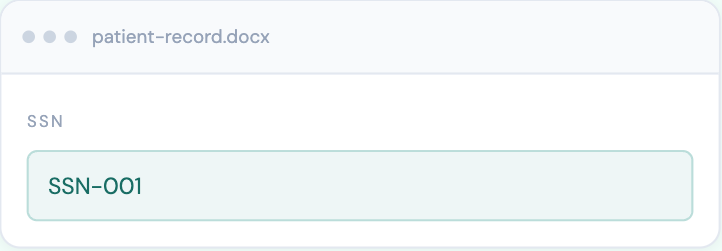
Definition: Sensitive unstructured data protection is the practice of enforcing persistent, granular security controls on sensitive information embedded within unstructured data, such as documents, files, and content, regardless of where that data is stored, shared, or used.
Unlike traditional approaches that focus on discovery or perimeter controls, sensitive unstructured data protection applies enforcement directly at the data layer.
Why Sensitive Unstructured Data Protection Exists
Most of the world’s sensitive data is unstructured.
This includes:
Contracts, legal documents, and financial records
Clinical, patient, and research data
Intellectual property and internal strategy documents
Files shared across collaboration tools and third parties
Unstructured data:
Does not live in databases with rigid schemas
Moves freely across systems, users, and organizations
Is frequently copied, shared, and reused
Why Unstructured Data Is Uniquely Risky
Sensitive unstructured data creates risk because:
It is difficult to inventory completely
It persists beyond access revocation
It is often shared outside
controlled systems
It is increasingly used by AI systems
Once unstructured data leaves its original environment, most controls no longer apply.
Protection must travel with the data itself.
What Sensitive Unstructured Data Protection Solves
Effective sensitive unstructured data protection enables organizations to:
Enforce controls that persist when data is shared or copied
Reduce third-party and insider risk
Protect sensitive elements without breaking usability
Prevent sensitive data from entering
AI workflows
Maintain compliance across distributed environments
Security shifts from managing locations to controlling the data itself.
What Most Organizations Get Wrong
Many security strategies fail because they confuse visibility with protection.
Discovery without enforcement:
Identifying sensitive data does not reduce risk if it remains usable and shareable
Perimeter-based security:
Network and application controls disappear once data moves.
Classification without control:
Labels do not stop data from being copied, embedded, or misused.
Access revocation as remediation:
Copies, exports, and AI usage persist beyond access removal.
Knowing where sensitive unstructured data exists is not the same as protecting it.
DSPM: Discovers and inventories risk but does not enforce protection
DLP: Focused on exfiltration, not persistent data usage
IRM / DRM: Breaks once data leaves the application
IAM / ZTNA: Controls access to systems, not data itself
Sensitive Unstructured Data Protection vs Common Alternatives
Sensitive unstructured data protection requires persistent enforcement, not episodic controls.
Classification alone: Informational, not enforceable
How Confidencial DefinesSensitive Unstructured Data Protection
Selective, object-level encryption
Preservation of non-sensitive context and usability
Policy enforcement that travels with the data
Auditable access and usage controls
Confidencial defines sensitive unstructured data protection as embedding enforceable, cryptographic controls directly into sensitive data elements so protection persists across systems, users, third parties, and AI workflows.
This approach enables
Protection becomes intrinsic to the data, not dependent on where it resides.
Why Sensitive Unstructured Data Protection Matters for AI
AI systems amplify unstructured data risk.
Unstructured content is:
Used for training and
fine-tuning
Embedded in RAG pipelines and vector databases
Files shared across collaboration tools and third parties
Once sensitive data enters AI workflows, exposure may be irreversible.
Sensitive unstructured data protection ensures:
Sensitive elements are excluded from AI ingestion
Non-sensitive context
remains usable
AI adoption does not compromise security or compliance
AI data governance starts with protecting unstructured data.
Where Sensitive Unstructured Data Protection Is Required
Sensitive unstructured data protection is essential wherever data moves beyond a single system:
Internal and external document sharing
Collaboration platforms and SaaS tools
Third-party data exchange
AI training, RAG, and inference workflows
Engineered for control. Architected for precision.
Hybrid and multi-cloud environments