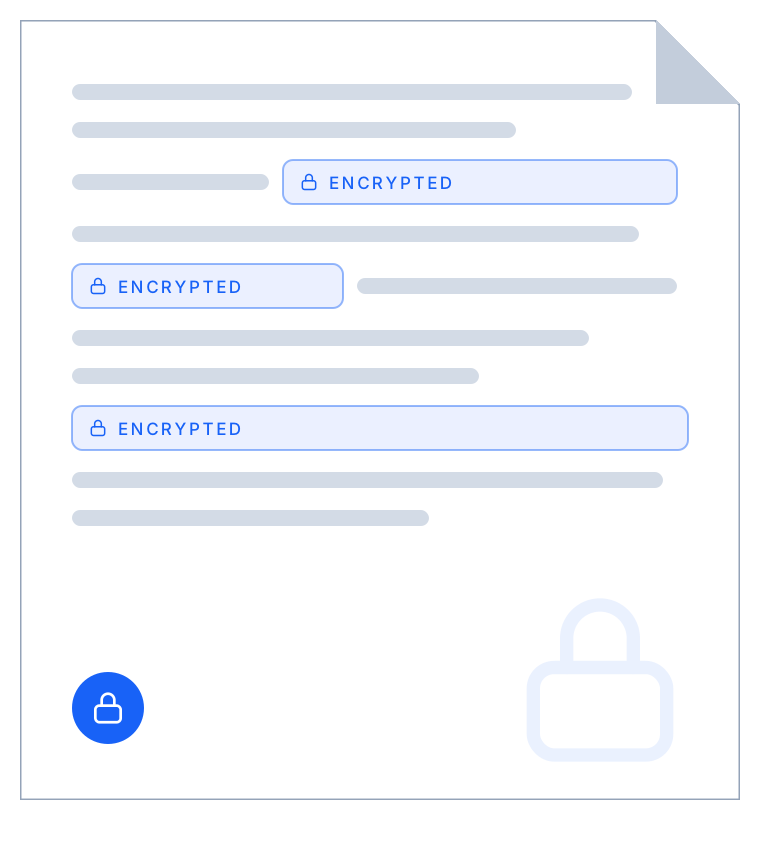
An engine that encrypts, redacts, or tokenizes individual fields, words, paragraphs, and pixels without breaking the file, format, or workflow. Protection travels with the data, everywhere it goes.
Different data, different risk profiles, different regulatory requirements. Selective protection applies the right mechanism to each sensitive entity, in the same document.
Sensitive entities are encrypted in place using public keys. The document is readable; the sensitive content is not. Policy controls access, and different entity types can be encrypted with different key groups. Authorized users see plaintext. Everyone else sees ciphertext, including the AI model, the vendor’s server, and the attacker who exfiltrated the file.
Sensitive entities are destroyed and it is irreversible. The document structure is preserved; formatting and surrounding content remain intact. The sensitive value is permanently gone. Used for court production, regulatory disclosure, and any scenario where permanent removal is the legal requirement rather than access-controlled visibility.
Sensitive information is replaced with meaningful placeholders that preserve context while protecting the underlying data. The original values are stored in a database and recoverable by authorized users. Built specifically for passing documents to LLMs, RAG pipelines, and AI agents without exposing the underlying values. The model processes structure and context without ever seeing what it shouldn’t.
Other tools encrypt entire files or entire disks. Selective protection operates at the element level, leaving context intact for the people and systems that need it.
SSN, account numbers, drug compounds, patient IDs, pricing
Named entities, counterparty names, key personnel, specific terms
Privileged legal analysis, deal terms, confidential findings
Spreadsheet ranges, salary bands, financial tables, formula outputs
Faces, signatures, ID documents, sensitive images within files
The document looks identical to everyone. They just can't read what they're not cleared to see. Patented selective protection is applied at the word, cell, or field level, embedded directly in the file. No redacted copies. No duplicate versions. One document. One key per element.
The breach still happens. What the attacker leaves with is ciphertext. Every exfiltration, AI exposure, vendor compromise, and insider action becomes a contained, auditable, defensible event.
Coverage ends when data leaves the system being protected. Selective protection is the only approach where coverage follows the data, into any environment, any AI system, any third-party tool.
| Tool | What it covers | Where coverage ends | With Confidencial |
|---|---|---|---|
| Full-disk encryption | Device at rest | Disk powers on. File copied off-device. No protection in transit, in use, in sharing, or in AI. | |
| DLP | Egress monitoring | The monitored network boundary. Blind to approved SaaS flows, authorized sharing, and AI ingestion. | |
| DSPM | Posture visibility | Discovery and classification only. A map of the problem, not a fix. No cryptographic protection applied. | |
| Rights Management (IRM) | File-level access policy | No field granularity. Vendor-ecosystem locked. Can't tokenize for AI pipelines. | |
| Traditional redaction | Visual blocking | Redaction errors are common and irreversible. No access-controlled mode. No AI-safe tokenization. No audit trail. | |
| Confidencial | The data itself | Doesn't. Protection travels with the file through sharing, exfiltration, AI ingestion, and third-party systems. All three modes in the same engine. |
Reduce risk, ease compliance, and unlock efficiencies.
Per-document cryptographic logs tell you exactly what was accessed and what wasn’t.
Tokenization lets sensitive data flow into LLMs and RAG pipelines without exposing values. Security enables AI adoption instead of blocking it.
Cryptographic audit trails embedded in the file replace checkbox attestation for HIPAA, PCI DSS, GDPR, and AI regulations.
Hybrid KEM/DEM architecture. Migration path to CRYSTALS-Kyber without re-encrypting existing data. Protected through the quantum transition.
This technology came out of cryptographic research at the institution that built the internet. It's not an idea. It's a commercialization of a solved problem.
SRI built ARPANET. The selective encryption and selective sharing architecture behind Confidencial emerged from DARPA-funded research into secure multiparty computation and resilient distributed systems — the institution that anticipated this threat class before anyone else.
Every cryptographic primitive is NIST-approved. Multi-layer AES + RSA + C11 format-preserving binding. Hybrid KEM/DEM architecture supports migration to CRYSTALS-Kyber without re-encrypting existing data. Data protected today is protected through the quantum transition.
SOC 2 Type II, ISO 27001:2022, HIPAA, PCI DSS SAQ-D, GDPR-aligned. Built for regulated industries where "we believe it was encrypted" is not an acceptable answer to a regulator or a plaintiff.
Assessed "Awardable" in the DoD CDAO Tradewinds Solutions Marketplace. AFWERX STTR Phase II contract for US Air Force sensitive document security. Environments where protection failure has national security consequences; this is the threat model the architecture was designed for.
We'll show you selective encryption, redaction, and tokenization running on your file types, in your workflows, against your actual threat model.