ConfidencialvsData Loss Prevention

DLP detects.
We protect.

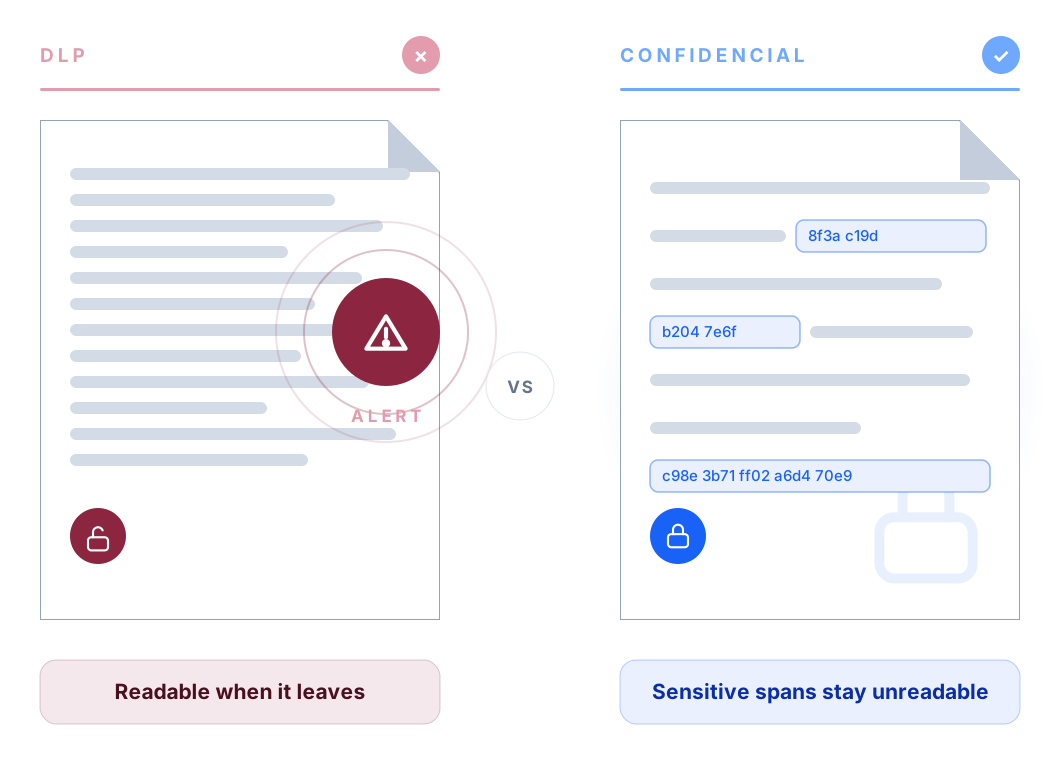
Data Loss Prevention tools inspect files on the way out and decide what to allow. Confidencial encrypts the sensitive content inside the file before it moves. A DLP miss means plaintext leaves. A Confidencial file that lands in the wrong hands stays unreadable.

confidencial vs dlp
4x increase
Increase in shadow AI as a non-malicious insider DLP event, now the third most common
IBM Cost of a Data Breach Report 2026
92%
Of organizations that suffered an AI-related breach had no AI access controls in place.
IBM Cost of a Data Breach Report 2026
$227,250
Added to the average breach cost by a business partner or supply chain compromise, the largest single cost factor of the 30 IBM analyzed.
IBM Cost of a Data Breach Report 2026

DLP vs data-layer protection, in one paragraph

TL;DR: Data loss prevention is a detection control. It inspects data at egress points and blocks transfers that match a rule. Confidencial is a protection control. It applies selective protection to the sensitive spans inside a file, using encryption, tokenization, or redaction, so the protection travels with the data after it leaves. DLP decides whether data is allowed to move. Confidencial decides whether data can be read.

The structural problem

The file left. DLP logged it. That's the gap.

DLP watches traffic at egress checkpoints and blocks transfers that match known patterns. Once data clears that checkpoint, whether to a vendor, into a retrieval index, or onto a personal device, DLP's coverage ends. Confidencial's doesn't. Every other layer in the stack protects a location. Encryption protects the thing itself.

Detection, not protection

Modern DLP is more than regex. Classifiers, fingerprinting, and exact data match all improve the odds. It is still a verdict, and a verdict can be wrong. When it is wrong, the file leaves readable.

Unmatched content passes

DLP acts on what it recognizes. Content that matches nothing moves in plaintext. Confidencial protects by policy, so a file does not have to be recognized to be protected.

Protection ends at the checkpoint

Once a file clears egress, DLP is done. Download it, forward it, or ingest it, and there is no coverage. Third-party involvement now appears in 48% of breaches  (15% two years ago, 30% last year, 48% today).

Verizon Data Breach Investigations Report 2026

Gating a prompt is not protecting a pipeline

Prompt-layer DLP can stop a user pasting a contract into a chat window. It does nothing about the sensitive content already embedded in your RAG index, vector store, or fine-tuning set. AI Guard protects the content itself, before ingestion and through retrieval.

Selective protection

One engine. Three modes. Applied to spans, not whole files.

DLP gives you one lever: allow or block. Selective protection gives you three, applied to the specific words, fields, cells, paragraphs, or pages that carry the risk. The rest of the document stays readable, searchable, and usable.

Encrypt

Reversible and access-controlled. Sensitive spans decrypt only for authorized identities, evaluated at the moment of access. Format preserved, so the file still opens in Office, Google Workspace, and PDF readers.

Tokenize

Reversible and semantics-preserving. Models and pipelines keep the surrounding context and the structure of the data without ever touching the sensitive values. Embeddings inherit the protection.

x

Redact

Irreversible. Used where sensitive content should not survive at all, such as sanitizing data before it enters a fine-tuning set.

What each approach actually covers

CapabilityTraditional DLPConfidencial
Protection mechanismHeuristic detection and policy blocking✓ Cryptographic selective protection
Failure mode✗ Fails open on unmatched content✓ Fails closed. No key, no access.
Coverage after the file leaves✗ None✓ Protection travels with the file
AI pipeline and RAG governance~ Gates prompts and app access✓ AI Guard protects content before ingestion and through retrieval
Insider threat~ Flags and blocks recognized patterns✓ Data unreadable without authorization
Third-party and vendor risk✗ No control once data is transferred✓ Access revocable after sharing
GranularityFile or message level✓ Word, field, cell, paragraph, region, or full document
Audit trail~ Event logs at the transfer point✓ Immutable, span-level log of every access
Post-quantum readinessn/a✓ Hybrid KEM/DEM with a CRYSTALS-Kyber migration path
Workflow disruption~ Blocks require manual review✓ File formats preserved, apps unchanged

✓ full capability · ~ partial or conditional · ✗ not covered

Honest assessment

What DLP is actually good at

DLP is a detection and compliance tool. It has real value in the right context. With Confidencial in place, DLP becomes a detection layer rather than a protection layer. It catches behavioral signals and policy violations. Confidencial handles what happens when those signals arrive too late, or don't arrive at all.

Defense-in-depth, not replacement

Confidencial sits beneath the controls you already run. Perimeter, identity, endpoint, and application layers each protect a location. This one protects the data. Both paths work. Most organizations run DLP and Confidencial together.

Compliance reporting and audit trails

DLP logs transfer events in formats regulators recognize. For PCI DSS, HIPAA, and SOX audit trails, those logs have genuine value, even if they don't prove protection.

Behavioral detection for known patterns

If an employee starts bulk-downloading files at 2am, DLP should catch it. Behavioral anomaly detection at the egress layer is a legitimate signal.

Policy enforcement for low-sensitivity transfers

For data that doesn't require cryptographic protection, DLP rules are a low-friction way to enforce transfer policies without adding encryption overhead.

Common questions

Common questions

What buyers ask when evaluating DLP against data-layer protection

What is the difference between DLP and encryption?

DLP is a detection control. It inspects data moving through a checkpoint and decides whether to allow or block it based on rules. Encryption is a protection control. It makes the data unreadable to anyone without the key, regardless of where the data goes or how it got there. DLP asks whether data should move. Encryption determines whether it can be read once it has.

Is DLP enough to protect sensitive data?

DLP protects data at the moments it is trying to move through a monitored channel. It does not protect data after download, after transfer to a vendor, or after ingestion into a retrieval index. If your risk sits in those places, DLP will tell you something happened without changing what the attacker or recipient ends up holding.

Does Confidencial replace DLP?

Not necessarily. DLP monitors egress behavior and produces compliance logs. Confidencial embeds cryptographic protection into the data itself. Many organizations run both. The question is where your actual risk sits. If it's at the egress point with known patterns, DLP addresses it. If it's in AI pipelines, third-party sharing, or after exfiltration, DLP doesn't reach there.

We already have Microsoft Purview. Why would we add Confidencial?

Purview does more than it gets credit for. It covers Microsoft 365, endpoints, on-premises file shares through the Information Protection scanner, and non-Microsoft cloud apps through Defender for Cloud Apps. It also gates Copilot prompts and blocks labeled content from AI processing. What Purview does not do is put protection inside the file. Once a document is outside a Microsoft-managed location, or already embedded in a vector index, Purview's controls are behind it. Confidencial reads the labels Purview already applied and turns them into cryptographic protection that stays with the content.

How does Confidencial handle data that DLP missed?

Protection is enforced by policy at the data layer rather than gated by a detection verdict at a checkpoint. You define which fields, data types, or document classes get protected, and Confidencial applies it. A document does not need to be recognized as sensitive at the moment it moves in order to already be protected.

What happens to our DLP investment if we add Confidencial?

DLP becomes a detection and compliance layer rather than a primary protection control. Its behavioral monitoring, audit logs, and compliance reporting stay valuable. What changes is the consequence of a miss. With Confidencial protecting the data, a DLP miss means a behavioral alert was missed, not that sensitive data left in plaintext.
See the difference

The question isn't if they get in. It's what they leave with.

Protection embedded in the data. Into AI pipelines, out to third-party vendors, or exfiltrated by an attacker, it travels with the file.

See how it worksBook a demo